Here are the monographs and edited volumes that I published in English (for a list of books published in German, see here)
Hot off the press (out in February 2026): States of Solidarity: How to build a society. Oxford, UK: Oxford University Press.
What does it takes for societies to organise around shared interests and responsibilities at a time of profound change? The book explores solidarity as a practical foundation for democratic life – across areas such as data and digital technologies, economic democracy, healthcare, and climate change – and shows how collective arrangements can help societies address inequality, uncertainty, and interdependence in more just and sustainable ways.
Pre-order it here: https://global.oup.com/academic/product/states-of-solidarity-9780198965350?q=prainsack&lang=en&cc=at (discounted e-books available in some countries)

Read the Preface (link is in the flyer)

Discount code:

2021 (with Hendrik Wagenaar): The Pandemic Within: Policy Making for a Better World. Bristol: Policy Press.
The Pandemic Within argues that the COVID-19 crisis did not create social and health inequalities but crystallised and made visible long-standing structural problems. Using the pandemic as an analytical lens rather than its endpoint, the book moves beyond diagnosis to propose actionable ways of building more equitable and more ecologically sustainable societies.

Order it here: https://policy.bristoluniversitypress.co.uk/the-pandemic-within
Reviews:
- The Pandemic Within: Policy Making for a Better World, by John Boswell, Critical Policy Studies 16/ 2 (27.03.2022)
- The Pandemic Within: Policy Making for a Better World, by Patsy Healey, Planning Theory & Practice (28.11.2022)
- The pandemic within: Policy making for a better world, by Renata Matsumoto, Canadian Journal of Education / Revue canadienne de l’éducation, 45/4: xxv–xxvii, (Winter 2022).
Also covered in ABC National Radio, Future Tense: Could Utopian thinking save democracy? Thursday 30 Jan 2025

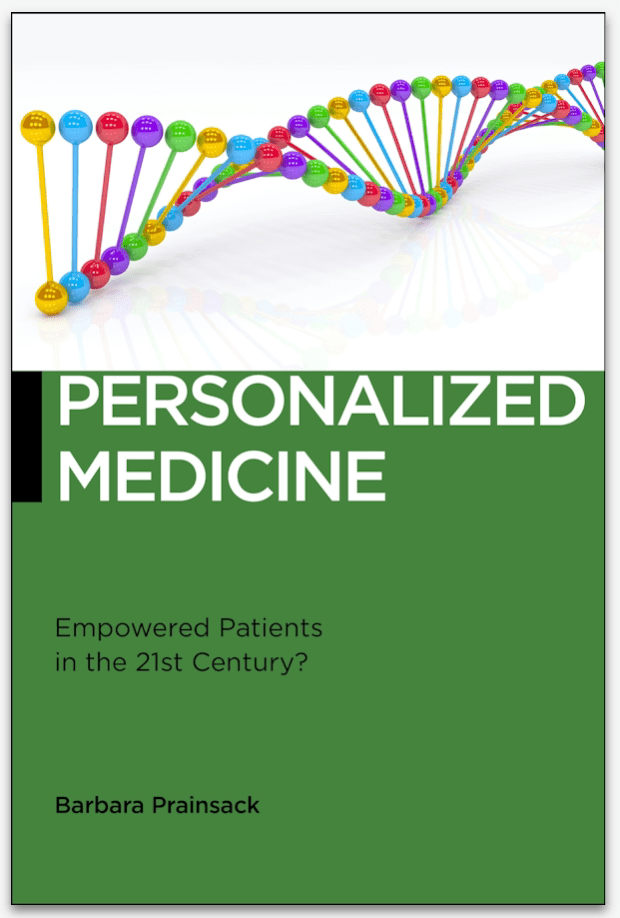
2017: Personalized Medicine: Empowered Patients in the 21st Century? New York City: New York University Press.
This book offers an analysis of personalised medicine as both a scientific vision and a sociopolitical project – and in particular, of the promises and challenges of data-driven personalisation in medicine. By combining empirical case studies with theoretical insights from STS, sociology, and bioethics, the book situates personalised medicine in broader debates about governance, solidarity, and the role of data in health care. It was shortlisted for the Sociology of Health and Illness Book Prize.
Order it here: https://nyupress.org/9781479814589/personalized-medicine/
Reviews:
- Personalized Medicine Is the Postgenomic Condition, by Carolyn O. Neuhaus, Hastings Center Report, 26.05.2018, Volume 48, Issue 3.
- Putting The Person in Personalized Medicine, by Consuelo H. Wilkins, Health Affairs, VOL. 37, NO. 5.
- Boxed Warning, by Laura Hercher, Genome (03.04.2018)
- Personalized Medicine: Empowered Patients in the 21st Century?, by Nadine Levin, Medical Anthropology Quarterly (16.08.2018)
- Personalized Medicine: Empowered Patients in the 21st Century, by Lauren Diamond-Brown, Social Forces, soz045 (14.05.2019)
- B Prainsack. Personalized Medicine: Empowered Patients in the 21st Century?, by Andrew Bartlett, Sociology of Health & Illness (17.05.2019)
- Personalized Medicine: Empowered Patients in the 21st Century?, by Linda M. Blum, K. J. Surkan, Contemporary Sociology: A Journal of Reviews (15.05.2019)
- Personalized Medicine: Empowered Patients in the 21st Century?, by Jeremy Freese, American Journal of Sociology 125/ 1 (1.07.2019)
- Justice and Solidarity in Post-genomic, Post-personalized Times, by Ayo Wahlberg, Science as Culture (06.08.2020)
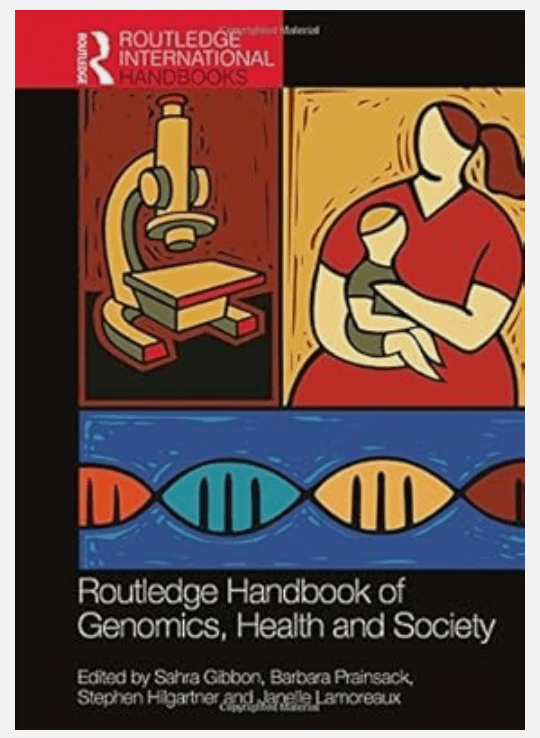
2018 (ed. with Sahra Gibbon, Stephen Hilgartner, and Janelle Lamoreaux): Handbook of Genomics, Health & Society. London: Routledge.
This Handbook provides an essential resource at the interface of Genomics, Health and Society. Building from and extending the first Routledge Handbook of Genetics and Society, the book offers a comprehensive introduction to central themes within the field as well as an overview of research at the interface of genomics, science and society.
Access it here: https://www.routledge.com/Routledge-Handbook-of-Genomics-Health-and-Society/Gibbon-Prainsack-Hilgartner-Lamoreaux/p/book/9780367659943
Reviews:
- Routledge Handbook of Genomics, Health and Society (2nd ed)., by Andrew Webster, New Genetics & Society 38/3: 352-354 (2018).
2017 (with Alena Buyx): Solidarity in Biomedicine and Beyond. Cambridge, UK: Cambridge University Press.
This book treats solidarity as both an analytical tool and a normative principle that connects everyday practices with institutional and policy frameworks in medicine, healthcare, and bioethics. Through case studies on health databases, personalised medicine, and organ donation, the book shows how solidarity can guide more equitable and socially responsive policies and practices.

Order it here: https://www.cambridge.org/core/books/solidarity-in-biomedicine-and-beyond/067DC974D204F6EDE679816213433456
Reviews:
- Barbara Prainsack, Alena Buys (2017) Solidarity in Biomedicine and Beyond, by Markus Zimmermann, Ethik Med (2020) 32:117–119 (23.01.2020).
- Solidarity in biomedicine and beyond, by Katherine Weatherford Darling, New Genetics and Society (15.03.2018)
- Barbara Prainsack and Aleny Buyx, Solidarity in Biomedicine and Beyond, by Mark Flear, Medical Law Review (03.03.2018)
- Book Review: Solidarity in Biomedicine and Beyond, by Edward S. Dove, SCRIPTed, 14/ 2 (12/2017)
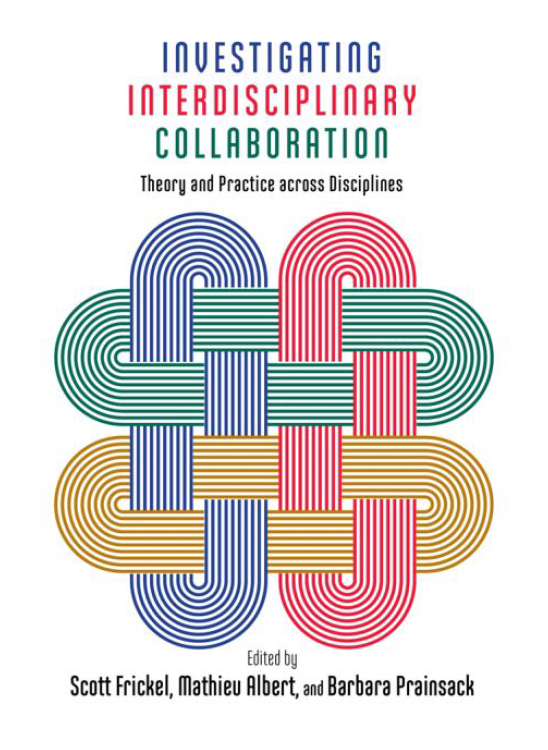
2016 (ed. with Scott Frickel and Mathieu Albert): Investigating Interdisciplinary Collaboration: Theory and Practice across Disciplines. New Brunswick, NJ: Rutgers University Press.
Interdisciplinarity has become a buzzword in academia, as research universities funnel their financial resources toward collaborations between faculty in different disciplines. In theory, interdisciplinary collaboration breaks down artificial divisions between different departments, allowing more innovative and sophisticated research to flourish. But does it actually
work this way in practice? This is the question that the contributors to this edited volume address from various disciplinary and geographical perspectives.
Order it here: https://www.rutgersuniversitypress.org/investigating-interdisciplinary-collaboration/9780813585888
Reviews:
- Investigating Interdisciplinary Collaboration Theory and Practice Across Disciplines, ed. by Scott Frickel, Mathieu Albert, Barbara Prainsack (review), by Roger Pizarro Milian, The Review of Higher Education 42/1: E4-E7 (2018).
- Investigating interdisciplinary collaboration: theory and practice across disciplines, by Robert Meckin, Barbara Ribeiro and Andrew Balmer, New Genetics & Society 37/3: 272-275 (2017).
2015 (ed. with Gabriele Werner-Felmayr and Silke Schicktanz): Genetics as Social Practice. London: Routledge.

Reviews:
- Genetics as social practice: transdisciplinary views on science and culture, by Yael Hashiloni-Dolev, New Genetics and Society, 34(4), 437–439 (2015).
2012 (with Helena Machado): Tracing Technologies: Prisoners’ Views in the Era of CSI. London: Routledge.
This book, which draws upon in-depth qualitative interviews with prisoners in Austria and Portugal, is also available in Portuguese: https://www.almedina.net/tecnologias-que-incriminam-1563800999.html

Order it here: https://www.routledge.com/Tracing-Technologies-Prisoners-Views-in-the-Era-of-CSI/Machado-Prainsack/p/book/9781138107502
Reviews:
- Tracing Technologies: Prisoners’ Views in the Era of CSA, by Gethin Rees, British Journal of Community Justice 12/1: 83-85 (2014).
- Book Review: Tracing Technologies: Prisoners’ Views in the Era of CSI, by Simon Cole. Social & Legal Studies, 22(4), 593-596 (2013).
- Tracing technologies: Prisoners’ views in the era of CSI, by David Wyatt, Genom Soc Policy, 15;8(1):61 (2012).
2010 (ed. with Richard Hindmarsh): Genetic Suspects: Global Governance of Forensic DNA Profiling and Databasing. Cambridge, UK: Cambridge University Press.

Order it here: https://www.cambridge.org/core/books/genetic-suspects/F69E6D2F9328CA8CD3BB38A509B9C47D
Reviews:
- DNA evidence, by Simon Cole, American Scientist (2010).
- Genetic Suspects: Global Governance of Forensic DNA Profiling and Databasing, by Shelby Montague, Yale J Biol Med 84/3:326 (2011).
 Barbara Prainsack