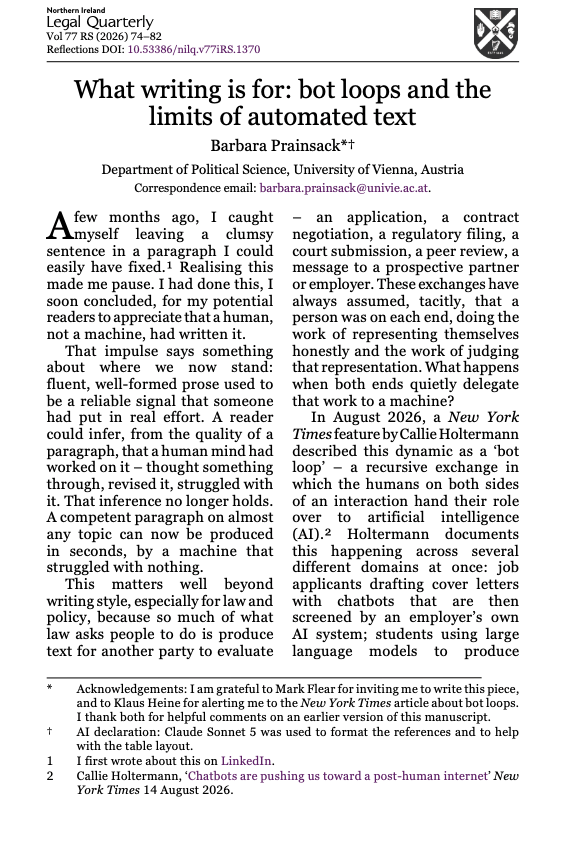
One of the most frustrating aspects of generative AI is the staleness of the writing that it produces. I feel that so many texts I read these days have no soul. I cannot put my fingers on exactly why.
The more soulless texts we read, the more important good human writing becomes. It does not need to be perfect to have a soul. Like human beings, scars and imperfections can make it come alive. They can make it beautiful.
In case it is helpful:

- I collated texts on good writing (in the social sciences specifically): https://barbaraprainsack.wordpress.com/2019/12/26/writing-well-in-the-social-sciences-recommended-readings/ (I will update it soon, I promise)
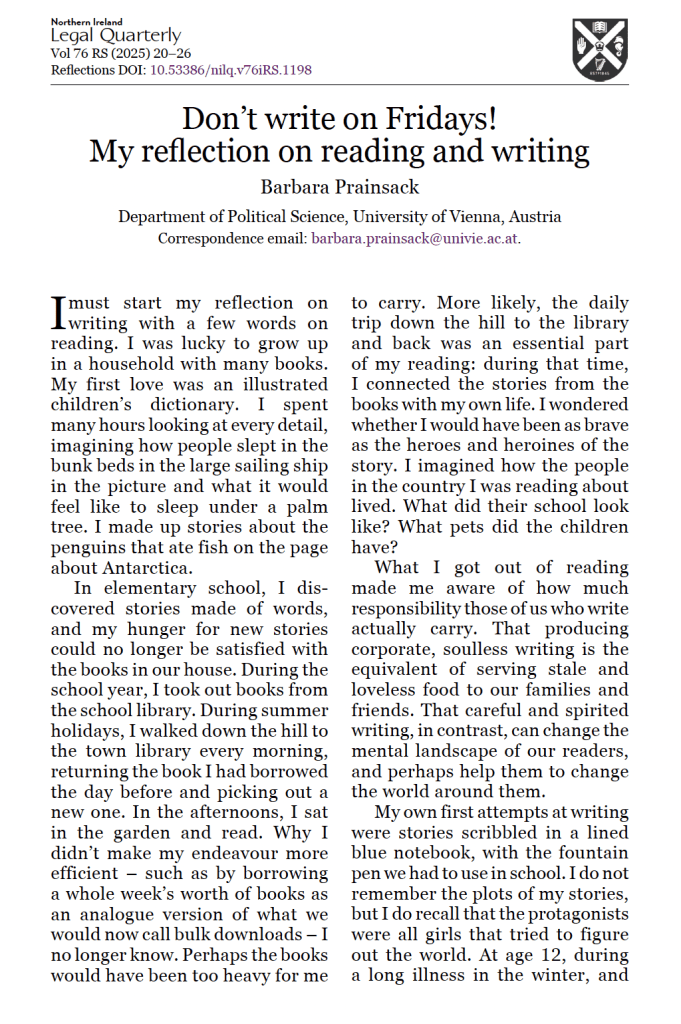
2. Here is my recipe for breaking through writers’ and other blocks. These blocks make us feel that writing is a chore rather than a pleasure. “Don’t write on Fridays”: https://nilq.qub.ac.uk/index.php/nilq/article/view/1198/972 ( 🙏 Mark Flear for inviting me to write this)
3. When is machine-generated text a problem, and when is it not?
A lot of people are complaining about machine-generated text causing deskilling, ‘brain rot’, and other bad things. In this piece in the same series on writing in the Northern Ireland Legal Quarterly, I distinguish between situations where machine-generated is unproblematic, and when it is harmful (short answer: when it erodes the meaning of social practice).
https://nilq.qub.ac.uk/index.php/nilq/article/view/1370/1107